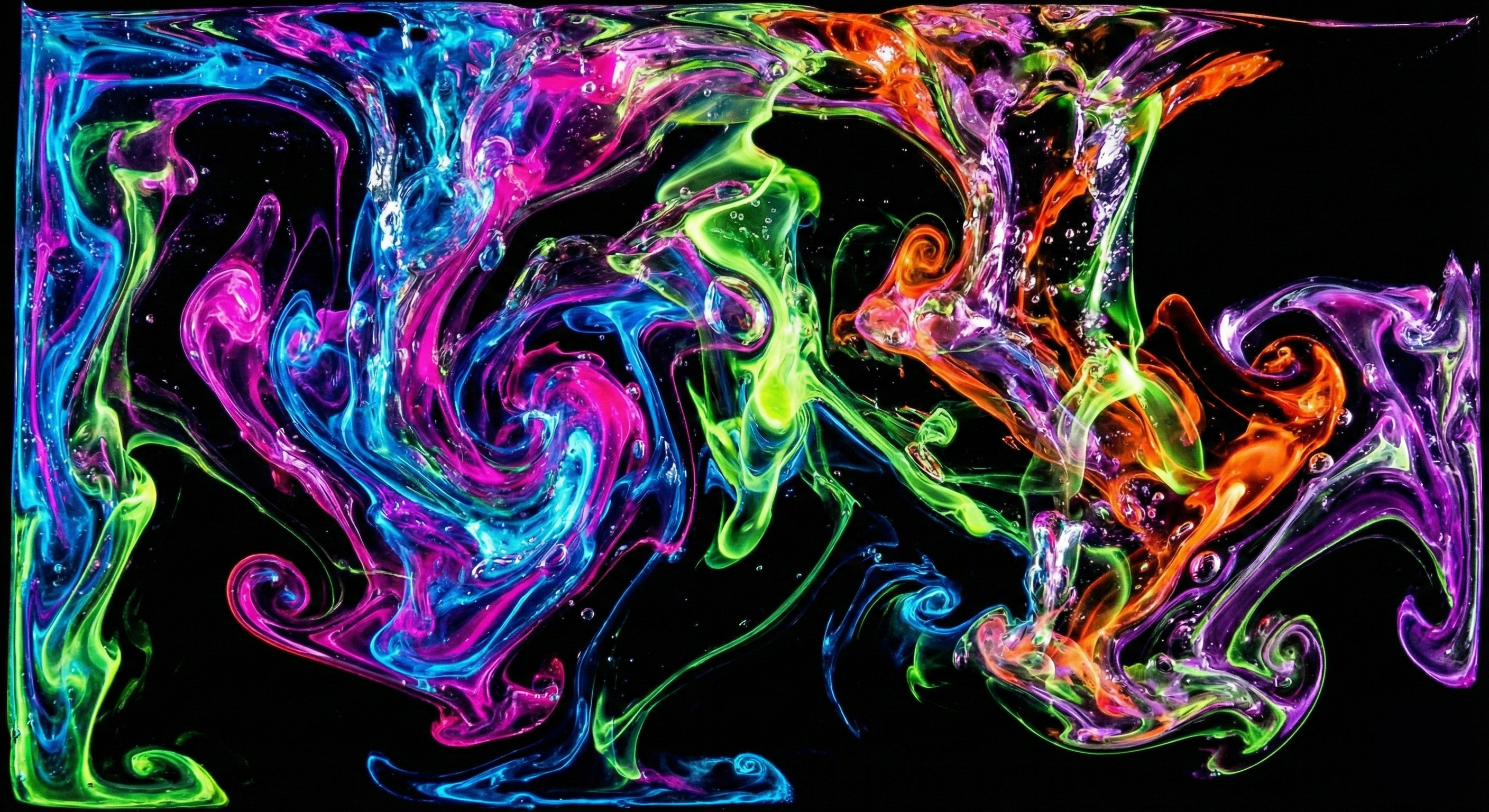
I always admire the phenomena of turbulent flow. It's something that, in real life, happens so quick that you don't really bother to try and stop to look at it. It's only in still images that you can experience the awe of complexity that it brings. To me, it seems fractal in nature. Although this is an inaccurate term when used literally, I mean it in the sense that it encourages you to look deeper to reveal more of the similar complexity.
Another angle of what makes this distinctly remarkable is that it is a visualisation of nature increasing entropy. Often the most prettiest of these images happens a short time after the dyes or materials are introduced, and just before they mix together too much to become indiscernible. In this window of time, the materials typically form a recognisable shape. Why these seem to be beautiful? I'm not quite sure.
There is also an interesting philosophical perspective here with regards to the use of AI to generate this image. Apart from a few artefacts on the edges, I believe one would not be able to reliably distinguish that this image was in-fact AI generated. One could argue that the concept of turbulent flow has no "correct" formation as it is an emergent phenomena. That is, to show this image to any person, most would be unable to give you a clear answer of whether it is right or wrong. To obtain such knowledge would be akin to solving the problems proposed by Wolfram on Rule 30. This has made me wonder if turbulent flow is merely a form of multi-dimensional cellular automata, but such contemplation is frivolous as it would extinguish its beauty from my mind, so I choose not to wander this path.
This is an AI-generated image.
Model: Gemini 3 pro - using the Gemini web app